The Scripts Behind Your AI (With a Western Blindspot)
The instruction manuals behind ChatGPT, Claude, Grok, and more got leaked. Our CPO analyzed all 250. Here's what nobody told you.
Share
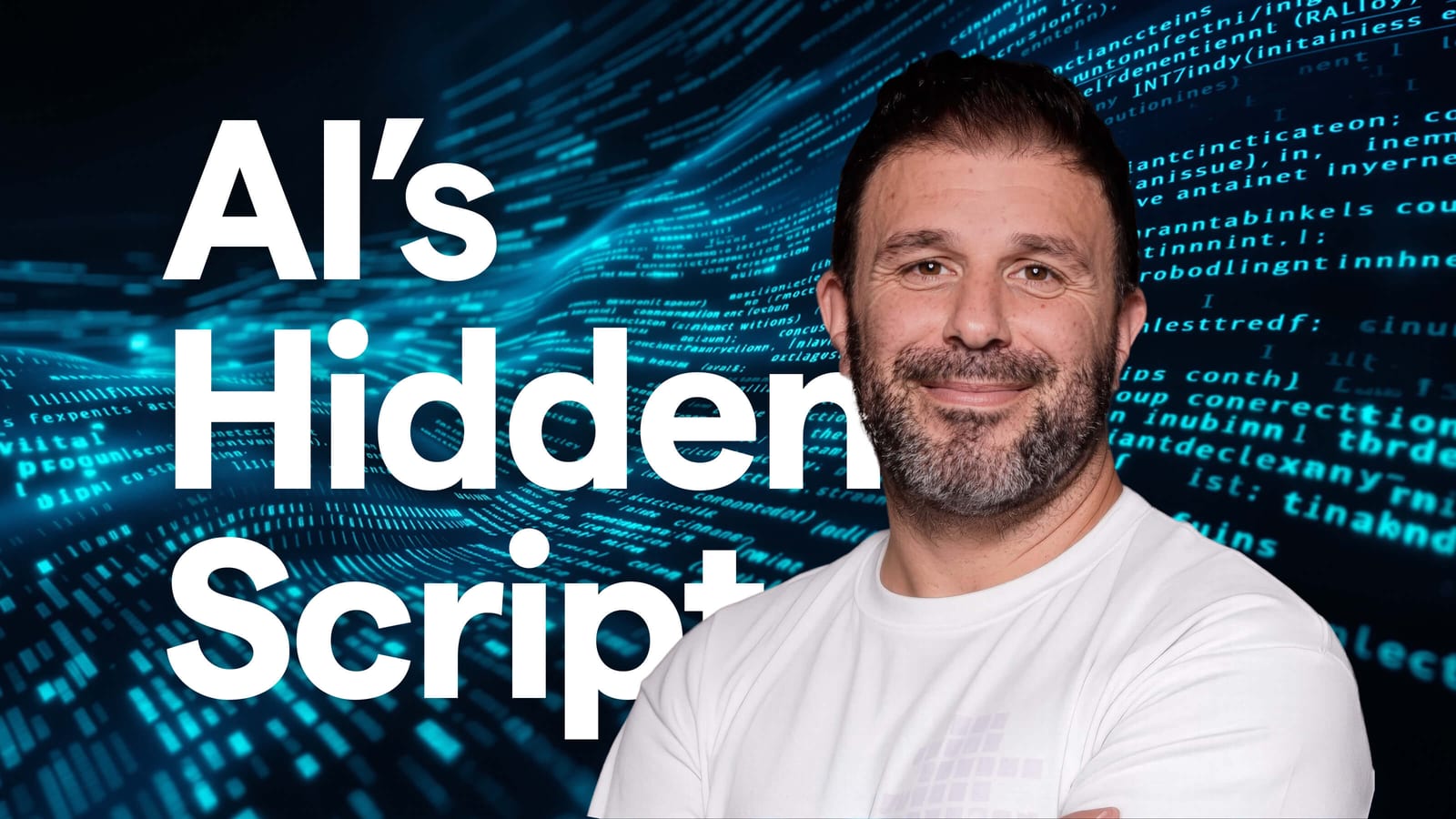
AI’s Hidden Scripts
Every chatbot you talk to is following a script it never shows you.
Our CPO Sebastian Rodriguez got hold of 250 of those scripts - leaked from 12 AI companies [1]. ChatGPT. Claude. Grok. And more. He analyzed all of them.
Here is what he found:
- they are more opinionated than a first read may suggest
- they are intentional and in many cases describe the company’s ethos and strategy (and even political views)
- some companies are fine-tuning while others are trying new approaches with every release (some know they have something that works, other are still looking for it)
- worth noting: no directly-censored topics (unlike Chinese models)
1. Anthropic wrote a novel. OpenAI wrote a Post-it.
Anthropic wrote about 33,800 words to tell Claude (Sonnet 4.6) who to be: one document, one character, always consistent. OpenAI wrote about 184 words to do the same job for ChatGPT. That's shorter than your last WhatsApp conversation. Every ChatGPT session is built differently with more flexibility. That's why Claude may feel like the same person every time while ChatGPT doesn't.
So you'd assume they're completely different products. Different values. Different brains.
They're not.
2. Strip away the logos. They're copying each other.
Same rules. Same patterns. Sometimes the exact same sentences. Whether they're borrowing from each other or just solving the same problems and facing the same challenges, the instructions, as I found, start to rhyme.
3. The only real difference is the voice.
Claude sounds careful and thoughtful. ChatGPT sounds like your helpful colleague. Grok sounds like it wants to start an argument. Don't underestimate that. In AI, wording is behavior - a single sentence in a system prompt can change everything: how the model thinks, responds, and refuses. But the underlying values? Closer than their reputations suggest.
4. A few real differences exist. But they're not what you think.
One is trust. Some AIs treat you like an adult. Others treat you like someone who needs protecting from information.
Another is politics. Grok used to call itself "politically incorrect." It quietly changed that to "not partisan, maximally truth-seeking." Claude was always told to present "the best case its defenders would make" - never its own opinion. Different starting points. Same finish line.
I also found out: what people say about these AIs hasn't caught up with what they actually are. The AI you used last month is not the same AI you're using today. They update the script silently. No announcement. No warning. It just changes.
5. Every AI was built for one type of person. And it's probably not you.
After 250 manuals, every single company assumes the following - without ever writing it down:
Western. Adult. Sitting alone at a computer. Almost certainly American.
(Children appear only as risk. Non-English speakers only as translation targets.)
This isn't just in the scripts. Behavioral scientists documented this blind spot decades ago - they even gave it a name: WEIRD. Western, Educated, Industrialized, Rich, Democratic. [2] AI didn't invent the assumption. It just scaled it.
- If every chatbot you've ever used is following a secret script that was written for someone who probably isn't you…
- If your AI treats you like everyone else…
- If companies writing those scripts are mostly copying each other the whole time…
Then maybe it's time for an AI that actually knows who you are. Not who it was told to assume. Our Proof of Uniqueness technology makes you verifiably, undeniably human.
At Billions Network, we're building the infrastructure for all 8+ billion people and their AI agents - not just the ones the script had in mind.
Full analysis: https://billionsnetwork.github.io/research-ai-system-prompts/ (via GitHub repository)

Full Analysis: The instructions behind the machine
Footnotes:
[1] GitHub archive: https://github.com/asgeirtj/system_prompts_leaks
[2] Henrich, J., Heine, S. J., & Norenzayan, A. (2010). "The weirdest people in the world?" Behavioral and Brain Sciences, 33(2-3), 61–83. https://www.cambridge.org/core/journals/behavioral-and-brain-sciences/article/abs/weirdest-people-in-the-world/BF84F7517D56AFF7B7EB58411A554C17 + PDF) - the foundational paper coining WEIRD, showing behavioral science routinely overgeneralizes from a narrow slice of humanity. AI training data follows the same pattern: GPT-3 was 93% English by word count (Brown et al. 2020, "Language Models are Few-Shot Learners", NeurIPS - https://ritvik19.medium.com/papers-explained-66-gpt-3-352f5a1b397 arxiv.org/abs/2005.14165 + https://arxiv.org/abs/2005.14165 + PDF); of the world's 7,000+ languages, only 7 are fully supported by AI systems today (Joshi et al. 2020, "The State and Fate of Linguistic Diversity and Inclusion in the NLP World", ACL - https://aclanthology.org/2020.acl-main.560/ + PDF)
Author: Sebastian Rodriguez, Chief Product Officer at Billions Network
Get this in your inbox
Product news, agent-commerce research and the occasional deep dive.